August 13, 2026 · appsec.training
How to Reduce SAST False Positives in Practice
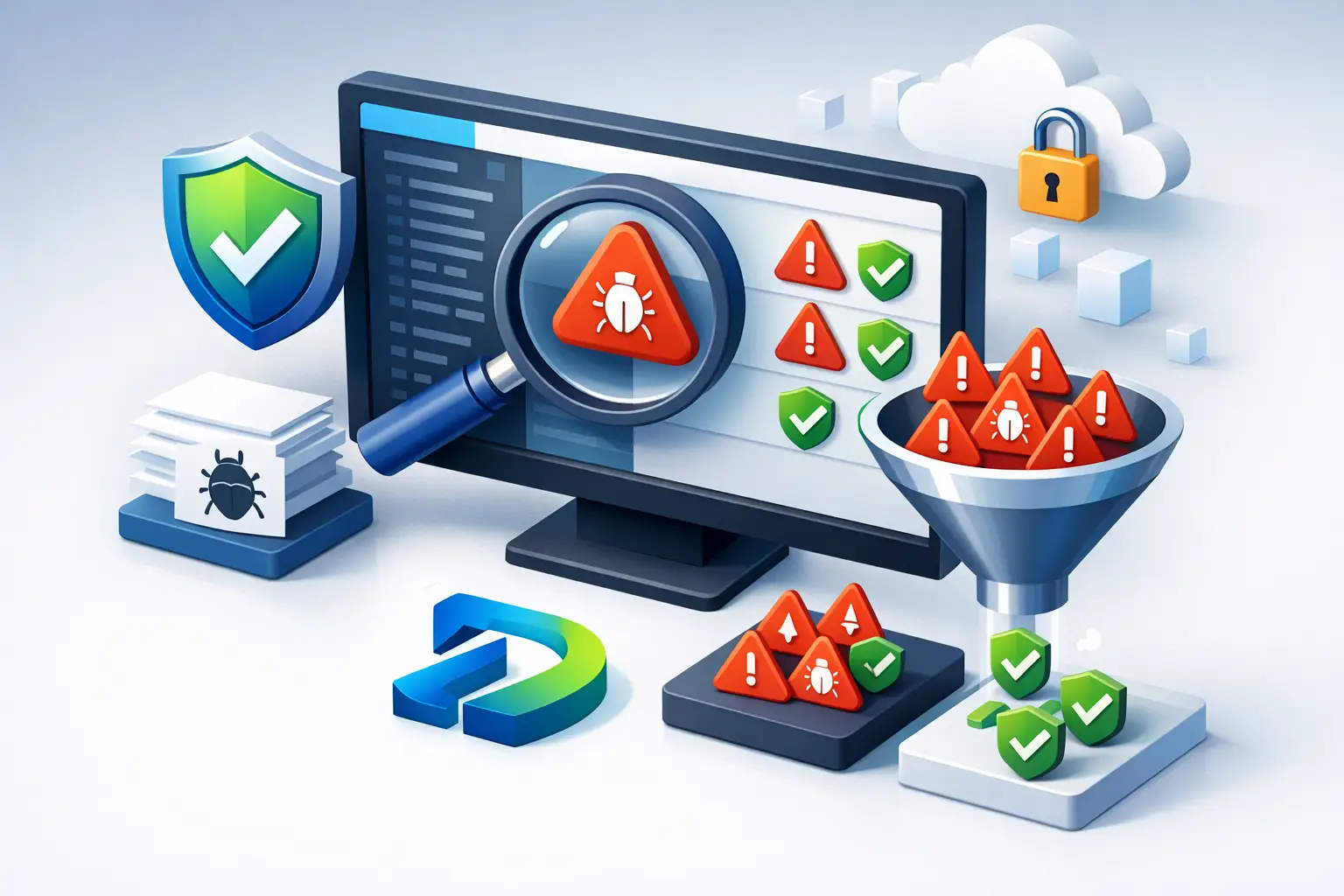
How to Reduce SAST False Positives in Practice
Learn how to reduce SAST false positives with scoped rules, better context, triage workflows, and developer feedback that improves secure delivery daily.
A SAST program loses credibility one ignored finding at a time. When developers repeatedly open alerts that do not apply to their code, they learn to treat the scanner as background noise. The practical answer to how to reduce SAST false positives is not to make the tool quieter at any cost. It is to make its findings more relevant, explainable, and connected to real security risk.
A useful SAST implementation detects vulnerabilities early without creating an unmanageable review queue. That requires technical tuning, disciplined triage, and feedback from the engineering teams expected to act on results.
Why SAST False Positives Become an AppSec Problem
A false positive is a finding reported as vulnerable when the code is not exploitable in its actual context. The distinction matters. A pattern may look dangerous in isolation, yet be protected by framework encoding, allowlisted input, an upstream validation control, or an execution path that is not reachable.
SAST tools work by analyzing source code, data flow, control flow, and known insecure patterns. They cannot always model every custom framework wrapper, deployment configuration, identity boundary, or runtime control. As a result, some uncertainty is expected. The problem starts when a program treats every alert as equally urgent.
High false-positive rates create two costly outcomes. Developers spend time disproving low-value findings instead of fixing real defects, while security teams lose the capacity to investigate the findings that deserve escalation. Lowering noise is therefore an operational objective, not just a scanner configuration task.
Establish a Baseline Before Changing Rules
Do not begin by disabling rules that generate complaints. First, measure the current state of the program. Review findings by rule ID, repository, language, severity, and disposition. Look for rules that are frequently marked not exploitable, duplicate, accepted risk, or mitigated by a standard control.
This analysis should separate a truly inaccurate rule from a rule that lacks context. For example, a SQL injection finding may be valid when untrusted input reaches a query builder. If the application uses a centralized parameterization wrapper that the scanner does not recognize, the rule is not necessarily wrong. The analysis is incomplete.
Track more than raw finding volume. Useful signals include the percentage of findings confirmed as valid, median time to triage, remediation rate for high-severity issues, and the number of findings reopened after a dismissal. These metrics show whether tuning improves decision quality or simply hides risk.
Tune Rules to the Code You Actually Ship
Default rule packs are designed for broad coverage across many organizations. Your development environment is narrower. It has specific languages, frameworks, libraries, architecture patterns, and risk boundaries. Rule configuration should reflect those conditions.
Start with the highest-volume, lowest-confidence rules. Review representative findings with a developer who understands the affected service and an AppSec engineer who understands the vulnerability class. Determine whether the rule should be adjusted, whether a missing sanitizer or framework behavior can be modeled, or whether the rule has little value for that codebase.
The safest tuning approach is precise. Narrow a rule to relevant file paths, functions, APIs, or languages rather than turning it off globally. If a rule is useful for internet-facing services but not for internal tooling, scope it accordingly. If an older framework version is vulnerable but the approved version is not, align the rule logic with the supported dependency range.
Custom rules can also improve accuracy, but they require governance. A custom rule should have a clear security rationale, test cases that include both vulnerable and safe examples, an owner, and a review date. Otherwise, a growing collection of undocumented exceptions becomes its own source of noise.
Improve Context for Taint and Data-Flow Analysis
Many high-impact SAST findings depend on whether attacker-controlled data reaches a sensitive sink. This is where configuration quality has a major effect on false positives.
Define the sources, sanitizers, and sinks that exist in your environment. Sources may include HTTP parameters, message queues, cookies, file uploads, and identity claims. Sinks may include database queries, operating system commands, template rendering, deserialization functions, and redirect APIs. Sanitizers are the validation, encoding, or parameterization methods that make a particular flow safe for a particular destination.
Be careful with the word “sanitizer.” A function that strips angle brackets may help in one HTML context but does not make data safe for a SQL query or shell command. Modeling a weak or context-specific function as a universal sanitizer can reduce alerts while introducing real blind spots.
Framework-aware analysis matters here. Modern frameworks often provide auto-escaping, ORM parameterization, route constraints, or safe APIs. Confirm how those protections behave and whether developers can bypass them. Then configure the scanner to recognize the protections only where their guarantees hold.
Build a Triage Workflow Developers Can Trust
Even well-tuned SAST produces findings that need human judgment. The goal is not zero alerts. The goal is a clear process for deciding what an alert means and what happens next.
A strong triage record states the vulnerability class, affected code path, source-to-sink evidence when relevant, exploitability conditions, business impact, and recommended remediation. “False positive” alone is not a sufficient disposition. The record should explain why the finding is not exploitable and identify the compensating control or unreachable condition.
Use a small set of consistent outcomes: confirmed vulnerability, false positive, duplicate, mitigated, accepted risk, or needs more information. Each outcome should have an owner and, when appropriate, an expiration date. Temporary suppressions should not become permanent simply because no one revisits them.
For high-severity findings, require peer review of dismissals. This does not mean turning every decision into a committee meeting. It means ensuring that a conclusion such as “input is trusted” has evidence behind it, especially when the code is exposed through an API, integration, or administrative workflow.
Put Findings Where Engineering Work Happens
A finding that arrives weeks after a merge is harder to validate and more expensive to fix. Run SAST in pull requests for changed code, then use scheduled full-repository scans to identify legacy issues and cross-project patterns.
Pull request feedback should be focused. Show the rule, affected lines, confidence, severity, and a remediation example that matches the language and framework. Avoid blocking builds on a newly enabled rule until the team has validated its accuracy. A phased rollout often works better: observe findings, tune the rule, establish a baseline, then enforce on newly introduced issues.
This approach protects delivery speed while preventing security debt from growing. It also gives AppSec teams evidence that a rule is ready for enforcement rather than relying on vendor defaults or intuition.
Use Suppressions as Controlled Exceptions
Suppressions are necessary in real codebases. They become dangerous when they are easy to add and impossible to audit.
A suppression should be as narrow as possible and include a reason. Prefer a line-level or code-path-level exception over disabling a rule for an entire repository. Require an issue reference or documented rationale for exceptions involving high-impact vulnerability classes. Where the tooling allows it, set expiration dates and report on suppressions that outlive the code or control they were meant to address.
Review recurring suppressions for patterns. If ten teams suppress the same finding because a shared validation library is not recognized, the right fix is likely improved rule modeling. If teams suppress a finding because the rule is difficult to remediate, investigate whether the engineering standard, secure library, or developer guidance needs improvement.
Validate Accuracy With Hands-On Testing
SAST tuning is a security engineering activity. Treat changes as code. Build a test corpus containing intentionally vulnerable examples, secure implementations, framework-specific patterns, and known edge cases from your repositories. Test every rule change against that corpus before broad deployment.
Then validate selected findings through secure code review and, when applicable, DAST or targeted manual testing. These methods answer different questions. SAST can identify risky code patterns before deployment; DAST can reveal whether a running application exposes an exploitable behavior. One should inform the other rather than replace it.
False-positive reduction always involves a trade-off. A more aggressive filter may improve developer experience but reduce coverage. A conservative rule may catch more edge cases but demand more triage. The right balance depends on application exposure, data sensitivity, the maturity of engineering controls, and the team’s ability to investigate findings quickly.
Developers trust SAST when it consistently identifies problems they can understand and fix. Building that trust takes practical knowledge of vulnerability mechanics, code review, threat modeling, and testing-tool behavior. That is the standard Application Security Engineers should work toward: fewer distractions, clearer evidence, and security findings that change the code before risk reaches production.